The Witch Rocks, Echo Canyon, Utah
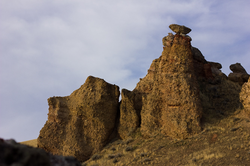
This project was interesting to work on because I had never written a paper based on my observations in the field. One problem that I ran into with the project was the fact that the area was blocked off with a No Trespassing sign. Naturally I ignored the sign to make my observations, but in the future I will try to determine if a site is easily and legally accessible before driving out to see it. While there is little correlation between what I learned during this assignment and other classes I have taken, I really enjoyed taking the things I had learned in class and in my research and making better informed observations in the field. I identified this site via the Utah Geological Survey's website, where they have an interactive map of interesting sites around the state. If I were to do this assignment again, I would probably prefer to go camping to make better use of the drive.
You can find a brief overview of the paper below:
Echo Canyon, Utah is home to several important and interesting geological sites which help explain the formation of the region. The Witch Rocks, or the Witches, are the most notorious of these formations as they have stood watch over the canyon for hundreds of thousands of years.
The Witches were first given their name in 1858 by United States Army Captain Albert Tracy. In his journal, he declared the rock formations to be “witch-like” and “so regularly like figures in kirtles and steeple-hats, or bonnets that they have received the appellation ‘Witch Rocks’ (Reference, 1858)."
To best understand the observations made at the geological site discussed in this paper, it is useful to look back at the formation of the region. Starting approximately 140 million years ago, a mountain building period known as the Sevier Orogeny began to shape the area now covered by Nevada and western Utah.
The mountains which formed in the Northwest played a critical role in the formation of the Witches. At the peak of the Sevier orogeny, the recently formed mountains began to erode and material was carried off by streams into the valley below. Due to the sediment being recently exposed, it primarily consisted of Cretaceous conglomerates common to the Sevier thrust faults. (Lawton, 2007)
The conglomerate that the Witches are composed of is varied in composition and possibly origin. Conglomerate is a clastic sedimentary rock which consists of two major components. Clasts are the rock or mineral chunks that are common to conglomerate. The Witches appeared to consist primarily of clasts the size of small boulders typically larger than 6 inches in diameter. Interspersed between these boulders were clasts the size of pebbles, typically sub-angular in shape. Clasts varied from carbonate rock to sandstone to quartzite — a particularly abundant material in this formation. The quantity of quartzite has led some geologists to believe that the conglomerate in Echo Canyon may also be from the Jurassic and Proterozoic periods in addition to the more rounded Cretaceous conglomerate common in the Sevier mountain belt (DeCelles, 1988). The second component of conglomerate is called the matrix, which refers to the material cementing the clasts together. In the Witches case, the matrix was observed to be a clay-like material, dry and somewhat flaky in texture. The clay matrix was interspersed with sub-angular granules roughly 2 millimeters in diameter.
The Witch Rocks have not always been exposed as they are now in Echo Canyon. As the conglomerate was deposited in the valley in alluvial fans, other sediments piled up around the fans as the valley slowly filled with depositional material. Eventually this material built up and was lithified, only to be eroded into the canyon millions of years later.
You can find a brief overview of the paper below:
Echo Canyon, Utah is home to several important and interesting geological sites which help explain the formation of the region. The Witch Rocks, or the Witches, are the most notorious of these formations as they have stood watch over the canyon for hundreds of thousands of years.
The Witches were first given their name in 1858 by United States Army Captain Albert Tracy. In his journal, he declared the rock formations to be “witch-like” and “so regularly like figures in kirtles and steeple-hats, or bonnets that they have received the appellation ‘Witch Rocks’ (Reference, 1858)."
To best understand the observations made at the geological site discussed in this paper, it is useful to look back at the formation of the region. Starting approximately 140 million years ago, a mountain building period known as the Sevier Orogeny began to shape the area now covered by Nevada and western Utah.
The mountains which formed in the Northwest played a critical role in the formation of the Witches. At the peak of the Sevier orogeny, the recently formed mountains began to erode and material was carried off by streams into the valley below. Due to the sediment being recently exposed, it primarily consisted of Cretaceous conglomerates common to the Sevier thrust faults. (Lawton, 2007)
The conglomerate that the Witches are composed of is varied in composition and possibly origin. Conglomerate is a clastic sedimentary rock which consists of two major components. Clasts are the rock or mineral chunks that are common to conglomerate. The Witches appeared to consist primarily of clasts the size of small boulders typically larger than 6 inches in diameter. Interspersed between these boulders were clasts the size of pebbles, typically sub-angular in shape. Clasts varied from carbonate rock to sandstone to quartzite — a particularly abundant material in this formation. The quantity of quartzite has led some geologists to believe that the conglomerate in Echo Canyon may also be from the Jurassic and Proterozoic periods in addition to the more rounded Cretaceous conglomerate common in the Sevier mountain belt (DeCelles, 1988). The second component of conglomerate is called the matrix, which refers to the material cementing the clasts together. In the Witches case, the matrix was observed to be a clay-like material, dry and somewhat flaky in texture. The clay matrix was interspersed with sub-angular granules roughly 2 millimeters in diameter.
The Witch Rocks have not always been exposed as they are now in Echo Canyon. As the conglomerate was deposited in the valley in alluvial fans, other sediments piled up around the fans as the valley slowly filled with depositional material. Eventually this material built up and was lithified, only to be eroded into the canyon millions of years later.
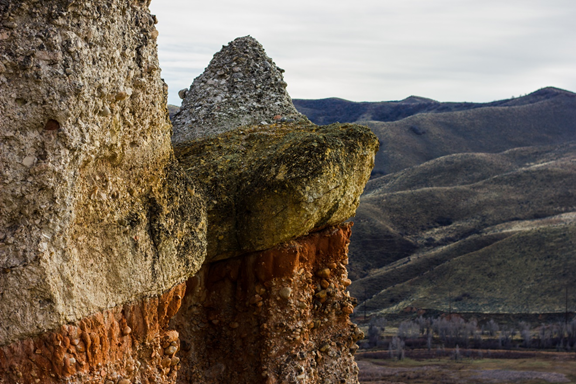
This photo is actually two separate towers, and is an excellent representation of the principle of lateral continuity.
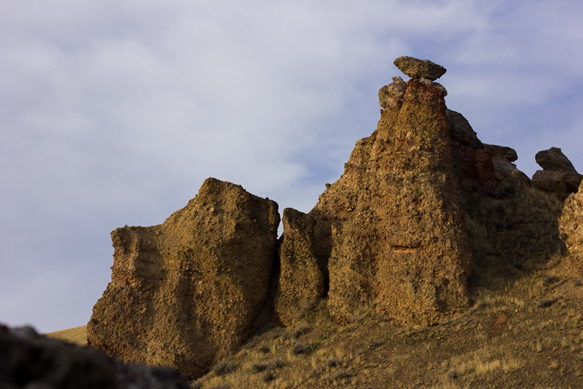
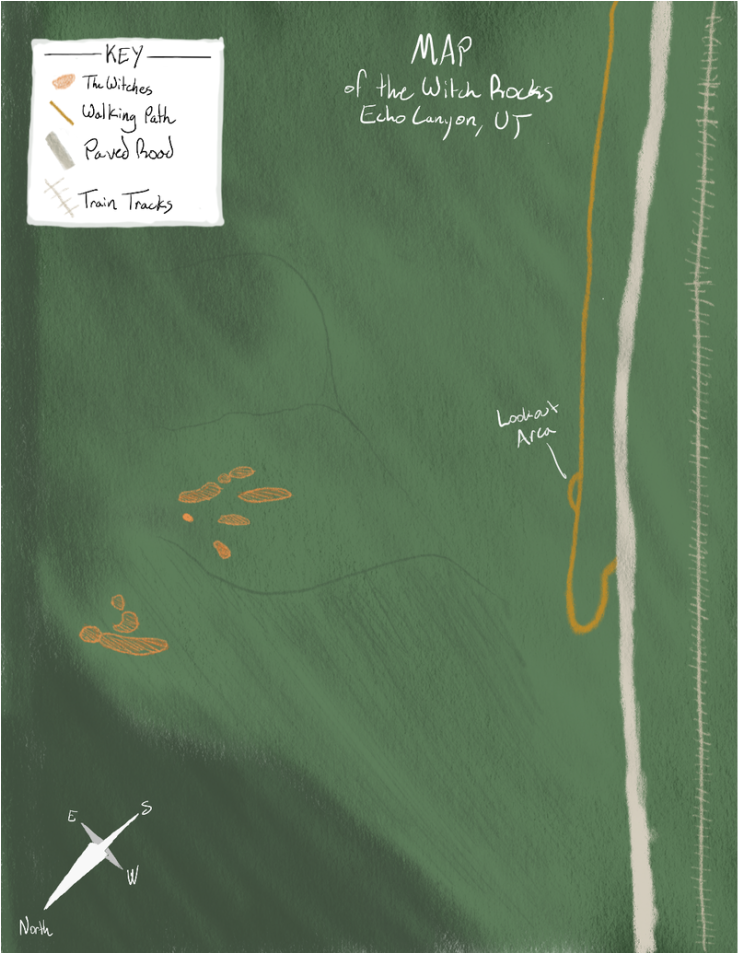
Wide shot exhibiting the shape of the Witch Rocks. It is easy to see why early travelers would see the shape of a witch in this formation.
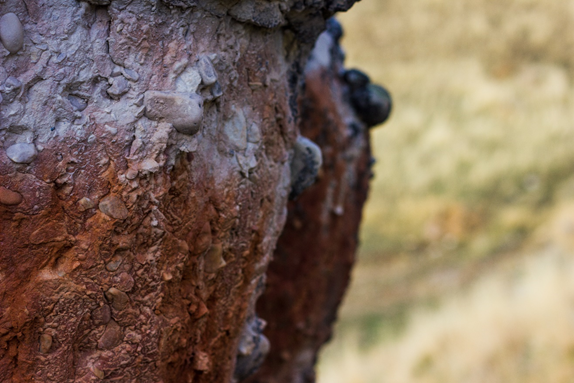
Medium view exhibiting the different layers present in each of the towers. Note the contrast between the red and white layers - while there may be some iron oxide present in the lighter-colored layer, the majority is in the dark red section.
Citations:
Armstrong, R. L. (1966, January 4). Sevier Orogenic Belt in Nevada and Utah [Abstract]. The Geological Society of America Bulletin, 79(4), 429-458. doi:0.1130/0016-7606(1968)79[429:SOBINA]2.0.CO;2
DeCelles, P. G. (1988). Lithologic provenance modeling applied to the Late Cretaceous synorogenic Echo Canyon Conglomerate, Utah: A case of multiple source areas. Geology, 16(11), 1039-1043.
Lawton, T. F., Sprinkel, D. A., & Waanders, G. L. (2007). The Cretaceous Canyon Range Conglomerate, Central Utah–Stratigraphy, Structure, and Significance.
Chicago
Livaccari, R. F. (1991). Role of crustal thickening and extensional collapse in the tectonic evolution of the Sevier-Laramide orogeny, western United States. Geology, 19(11), 1104-1107.
Armstrong, R. L. (1966, January 4). Sevier Orogenic Belt in Nevada and Utah [Abstract]. The Geological Society of America Bulletin, 79(4), 429-458. doi:0.1130/0016-7606(1968)79[429:SOBINA]2.0.CO;2
DeCelles, P. G. (1988). Lithologic provenance modeling applied to the Late Cretaceous synorogenic Echo Canyon Conglomerate, Utah: A case of multiple source areas. Geology, 16(11), 1039-1043.
Lawton, T. F., Sprinkel, D. A., & Waanders, G. L. (2007). The Cretaceous Canyon Range Conglomerate, Central Utah–Stratigraphy, Structure, and Significance.
Chicago
Livaccari, R. F. (1991). Role of crustal thickening and extensional collapse in the tectonic evolution of the Sevier-Laramide orogeny, western United States. Geology, 19(11), 1104-1107.